Contractors to Repair Damaged Roads at Their Own Expense Within Three Years Under New Government Directive
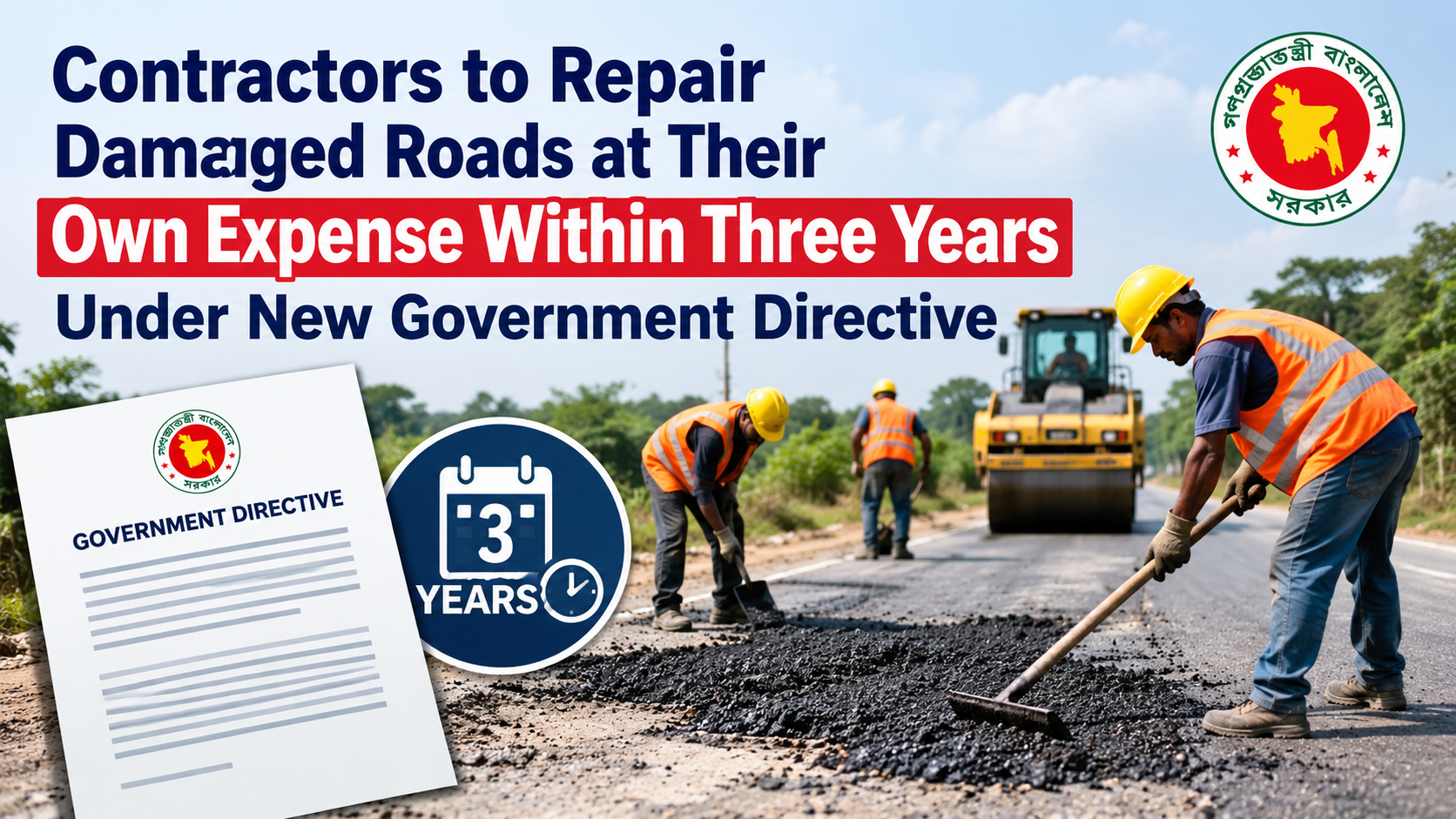
The Bangladesh government has directed that new guarantee clauses be included in contracts for government-funded road construction and other infrastructure projects. Under the proposed arrangement, contractors will be required to repair major defects caused by poor construction quality at their own expense if they emerge within three years.
The initiative aims to improve the quality of public infrastructure, strengthen contractors’ accountability and reduce the need for repeated repairs that increase government expenditure.
The directive was discussed at a meeting of the Executive Committee of the National Economic Council (ECNEC) on October 7, 2026, chaired by Prime Minister Tarique Rahman. Planning State Minister Zunaid Abdur Rahim Saki briefed journalists on the decisions following the meeting.
Three-Year Guarantee to Hold Contractors Accountable
Under the proposed contractual arrangement, contractors will have responsibilities beyond simply completing construction work. If significant defects arise within the three-year guarantee period because of poor construction quality, the contractors concerned will be required to carry out repairs at their own expense.
The proposed guarantee clause is intended to discourage substandard construction and encourage contractors to maintain the required quality throughout the project.
However, the requirement does not necessarily mean that contractors will be responsible for every instance of road damage within three years. The reported directive focuses on major defects attributable to construction quality. The precise scope of liability will depend on the applicable contract terms and implementation rules.
Drainage to Be Considered in Road Construction
Poor drainage is another factor that can shorten the lifespan of roads, particularly in residential areas and regions that experience heavy rainfall.
When rainwater accumulates on road surfaces, it can damage the pavement and gradually weaken the underlying structure. To address this issue, the government has also emphasised the need to incorporate appropriate drainage arrangements into road projects in residential areas.
The measure is intended to ensure that infrastructure planning takes account of local conditions rather than focusing exclusively on road construction.
Effective implementation will require proper planning, quality materials and regular supervision to ensure that drainage systems are built according to approved designs.
Government Seeks Better Value for Public Spending
The government’s focus on construction quality comes amid broader efforts to ensure that public development expenditure delivers lasting benefits.
At the October 7 ECNEC meeting, 13 development projects involving a total estimated cost of Tk 16,207.55 crore were reported to have received approval.
Roads that deteriorate soon after construction often require additional public spending on repairs or reconstruction. Such damage can also disrupt transportation, increase travel times and create difficulties for residents and businesses.
By making contractors responsible for qualifying construction defects during the guarantee period, the government aims to reduce the financial burden on public authorities and encourage better workmanship.
Nevertheless, the effectiveness of the measure will depend on whether the contractual conditions are clearly defined and consistently enforced.
Parliamentary Committee Recommends a Three-Year Warranty for Rural Roads
Separately, a parliamentary standing committee associated with the Ministry of Local Government, Rural Development and Co-operatives recommended on October 11 that contractors’ security deposits for rural road projects be retained for three years to help ensure construction quality.
The committee also stressed the importance of closer supervision of rural road construction.
The recommendation concerning security deposits is distinct from the ECNEC directive on introducing guarantee clauses into contracts. Although both initiatives seek to strengthen accountability, their implementation and legal implications may differ.
Implementation Will Be the Key Challenge
The proposed guarantee requirement could improve the durability of publicly funded infrastructure, but its success will depend on several practical factors.
Authorities will need to establish clear standards for identifying construction-related defects, conduct inspections after project completion and determine how contractors must respond when problems are discovered. Effective enforcement mechanisms will also be necessary if contractors fail to carry out the required repairs.
Proper documentation of construction materials, technical specifications and inspection results will be important in determining whether damage resulted from poor workmanship or other causes.
The government’s initiative represents an effort to make infrastructure contractors more accountable for the quality of their work. Whether it leads to longer-lasting roads and lower maintenance costs will ultimately depend on how consistently the new contractual requirements are implemented.